
When Upper Deck entered the hockey-card market in 1990-91, it arrived during one of the biggest collecting booms the hobby had ever seen. Upper Deck upped the game and brought glossy card stock and sharp photography, immediately giving the product a more premium feel than many traditional releases from Topps, O-Pee-Chee, and Minted ProSet.
They also introduced something that would eventually become one of hockey collecting's most recognizable names: Young Guns.
The original 1990-91 Young Guns group consisted of a checklist followed by 15 players, including Sergei Fedorov, Pavel Bure, Peter Bondra, and Robert Reichel. There were NO goalies released in the first set. At the time, however, Young Guns weren't the hobby institution they are today. They were simply a rookie-oriented subset buried inside a massively produced early-1990s product.
Young Guns actually disappeared from Upper Deck's flagship product after 1992-93, briefly appearing under the Collector's Choice brand before eventually returning to Upper Deck in 1999-00.
That return changed everything.
Upper Deck made a bold move, transforming the Young Guns subset into short-printed rookie cards. Instead of simply being another card in the set, they became something collectors had to pull. For many years, Young Guns fell at roughly one every four packs — difficult enough to make them desirable, but attainable enough that collectors could chase an entire set.
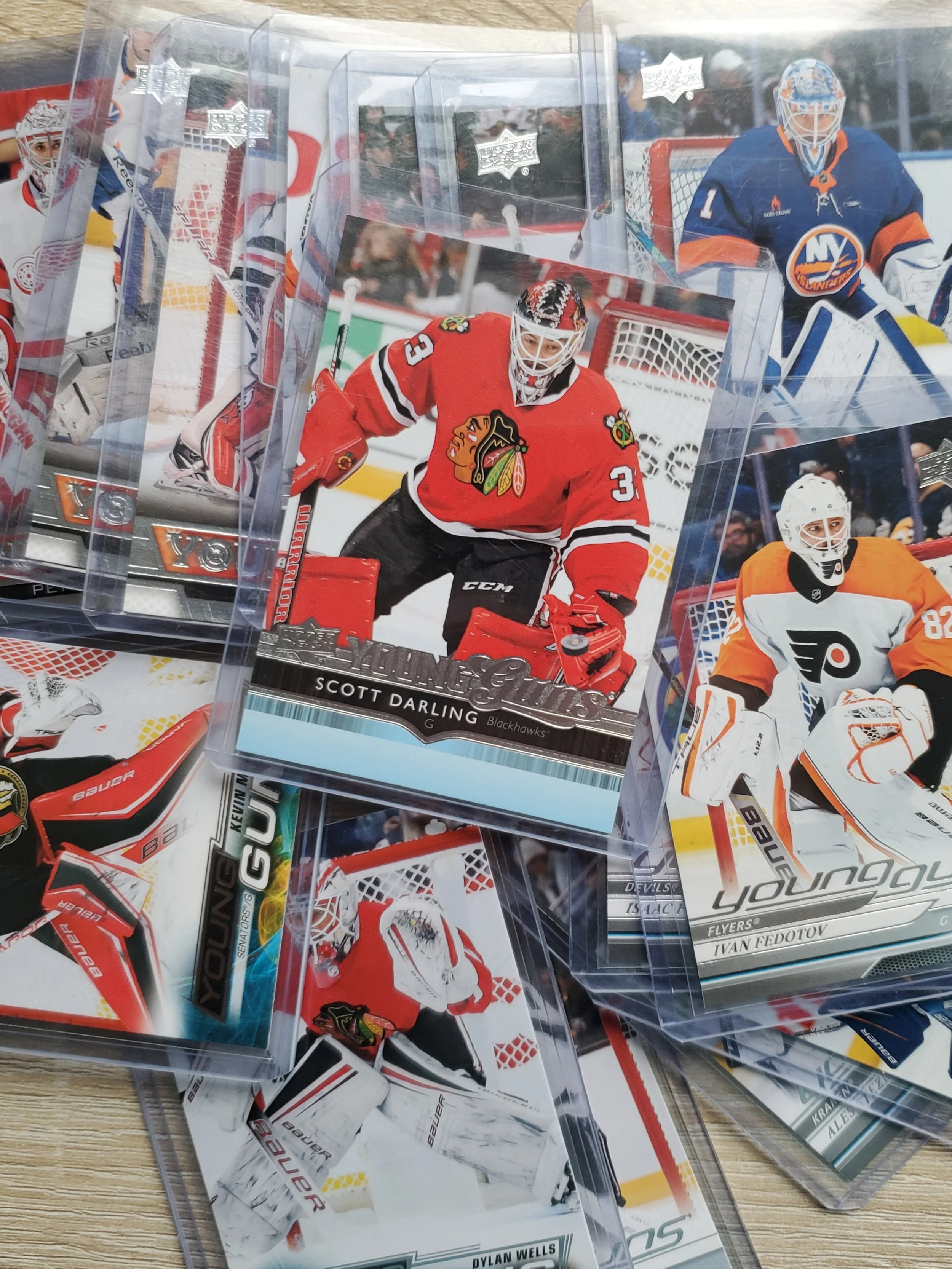
What About the Goalies?
Interestingly, for goalie collectors, there wasn't a single goalie in the original 1990-91 Young Guns lineup. The 15-player group was entirely made up of skaters. Goalies such as Curtis Joseph, Mike Richter, Rick Tabaracci, and Daryl Reaugh had rookie cards in the 1990-91 Upper Deck, but they weren't Young Guns.
By the time Young Guns returned to the flagship set in 1999-00, that changed dramatically. One of the most important cards in the revived Young Guns era was a goalie: Roberto Luongo. His 1999-00 Upper Deck #357 Young Guns became an important rookie card from the early years of the modern format. The Luongo's glossy surface, dark blue-and-black lower borders, and bronze-foil accents make it tough to land a high grade from PSA.
The card’s dark edges readily show whitening, while the glossy/foil surface can reveal scratches, scuffs, and print lines; centering is another potential problem. As a result, a card that looks clean in a binder can be considerably tougher under a grading company's scrutiny.
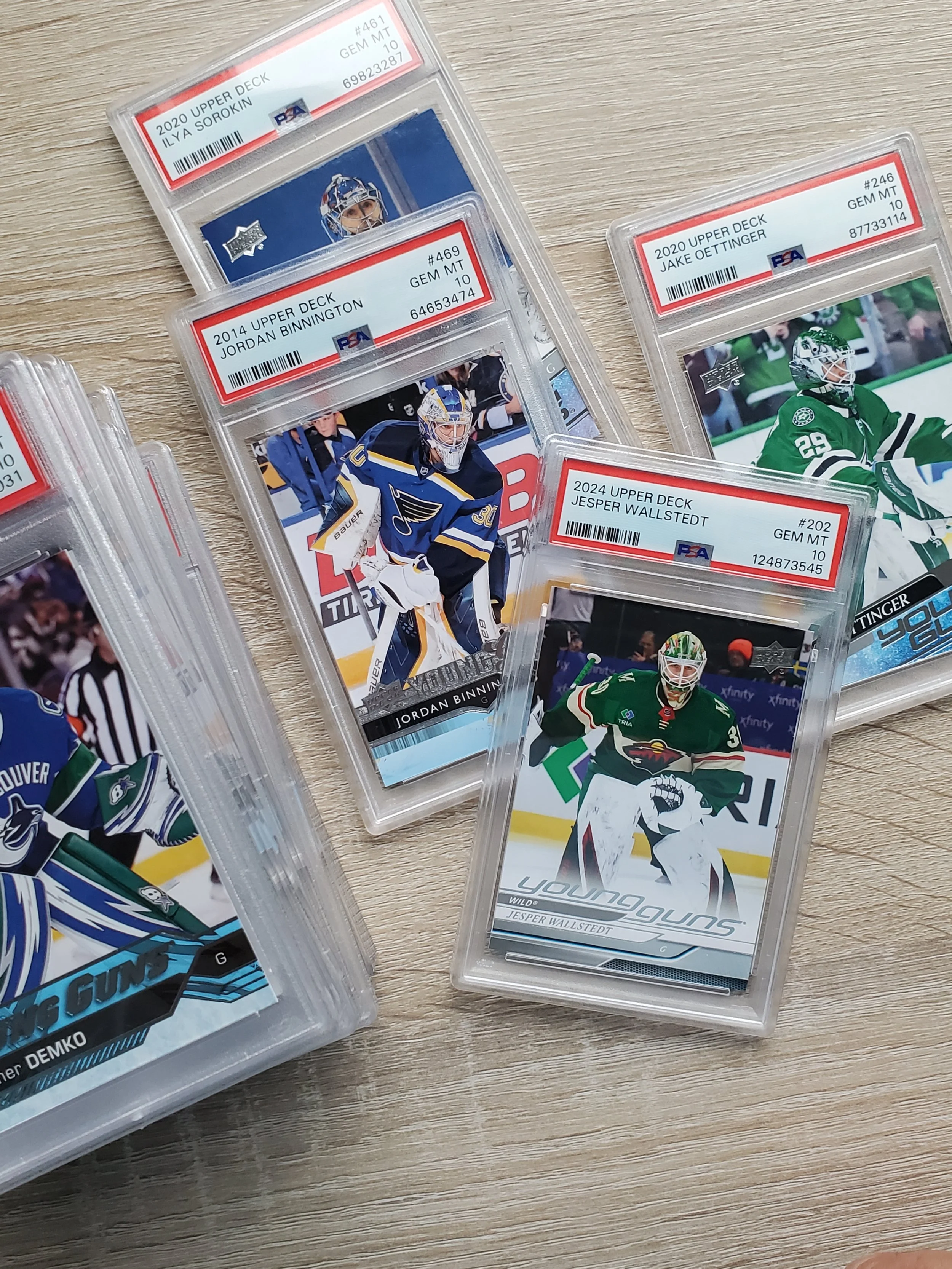
Today
Young Guns succeeded because Upper Deck found a nearly perfect formula. They aren't autographed. They don't contain pieces of jerseys. Most aren't serial numbered. They're simply recognizable “short-printed” rookie cards from Upper Deck's flagship NHL product.
That simplicity has become their strength.
Cards of superstars including Sidney Crosby, Alexander Ovechkin, Carey Price, Vasy, McDavid, and Connor Bedard have helped turn Young Guns into the unofficial rookie-card standard of modern hockey collecting.
