
Why Rarity Doesn't Always Mean Value in Hockey Card Collecting
One of the biggest misconceptions in hockey card collecting is that if a card is rare, it must be valuable. While that sounds logical, the hobby doesn't always work that way. Value is driven by demand just as much as scarcity, and sometimes the rarest cards in the world are only worth cents.
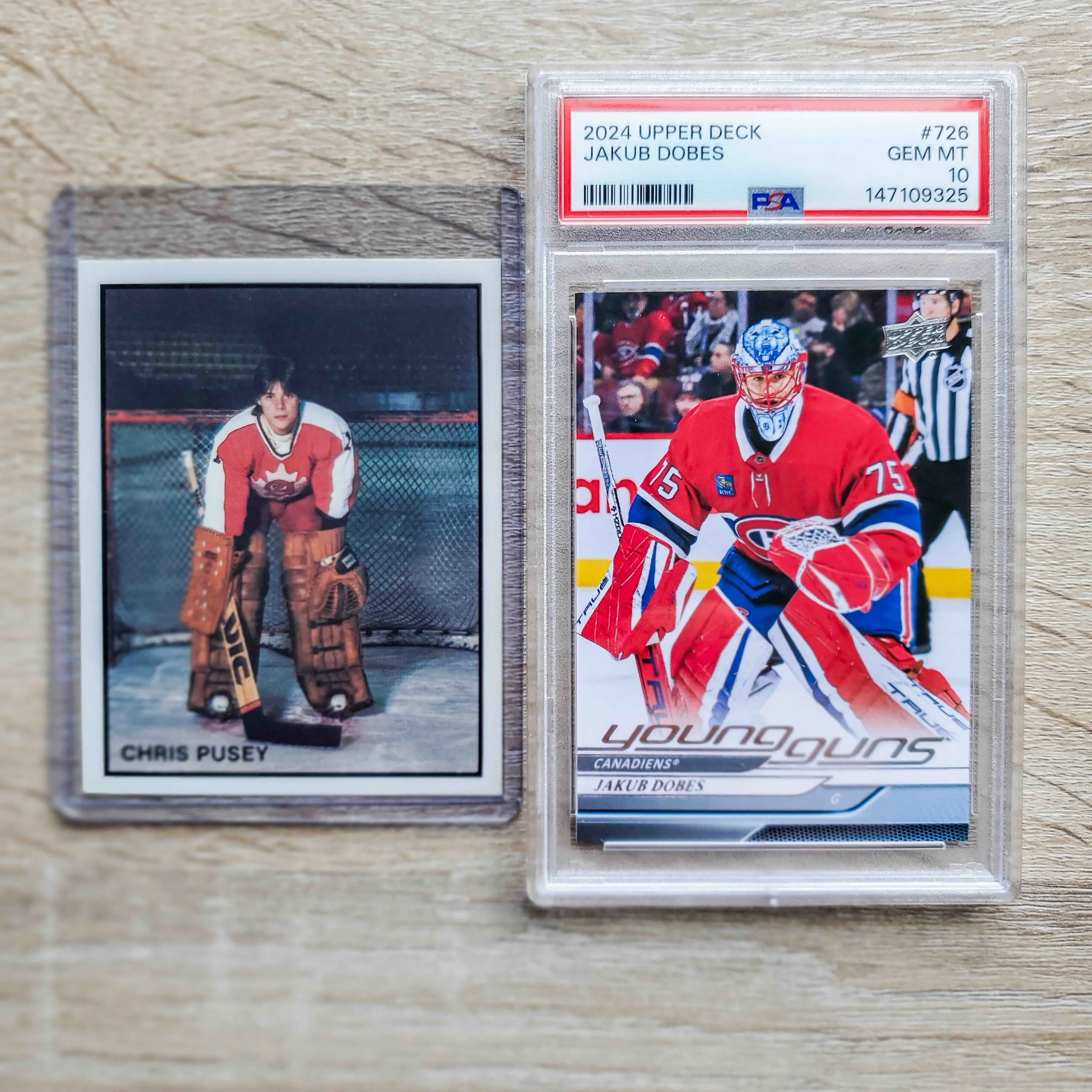
Chris Pusey rare and worthless. Jakub Dobes easy to find worth a ton.
I was reminded of that while searching for a 1983 Chris Pusey rookie card I was chasing.
On paper, it's hardly an exciting card. Most people wouldn't give it a second glance; it would never appear in a dealer's showcase. There’s the problem—it never appears in showcases. Instead, it sits buried somewhere in thousands of forgotten cards packed away in dusty storage boxes.
I ended up posting a bounty of $125 for that single card.
That got a bunch of people off their couches to dig for the prize. I had been looking 5 years for that card. Within 2 hrs of posting my ridiculous bounty, someone happily DM’d me with one for sale.
Was the card worth $125? Fuck no.
What I was really paying for was someone's time to look for it. I needed a collector to dig through his countless random boxes filled with thousands of cards to find one obscure rookie that nobody else was looking for. That search could take hours, and the only way to motivate someone to do it was to make it worth their effort.
That's something many collectors don't realize. A card's market value and its acquisition cost are two completely different things.
The same principle applies throughout the hobby. There are countless regional issues, minor league releases, European sets, and oddball promotions that are incredibly scarce. Some may have print runs far lower than famous rookie cards, yet they sell for only a few dollars because there simply isn't enough demand. Conversely, a card with thousands of copies can command hundreds or even thousands of dollars because a lot of collectors are chasing it.
For goalie rookie card collectors like me, the equation changes even more. Most goalies who played in the NHL have rookie cards that are worthless. Worse, they surface even less. When one finally appears, you don't necessarily pay for the cardboard—you pay for the opportunity. There may not be another chance to get one for years.
That's one of the things I love most about hockey card collecting. It isn't always about chasing the most expensive cards, though many times, in fact most times, I have to overpay for a card.
Sometimes the greatest thrill comes from tracking down that impossible-to-find random AHL or Junior card.
In the end, rarity creates the hunt, but demand creates the value. And every once in a while, a twenty-five-cent card costs $125 simply because finding it is worth more than the card itself.
